

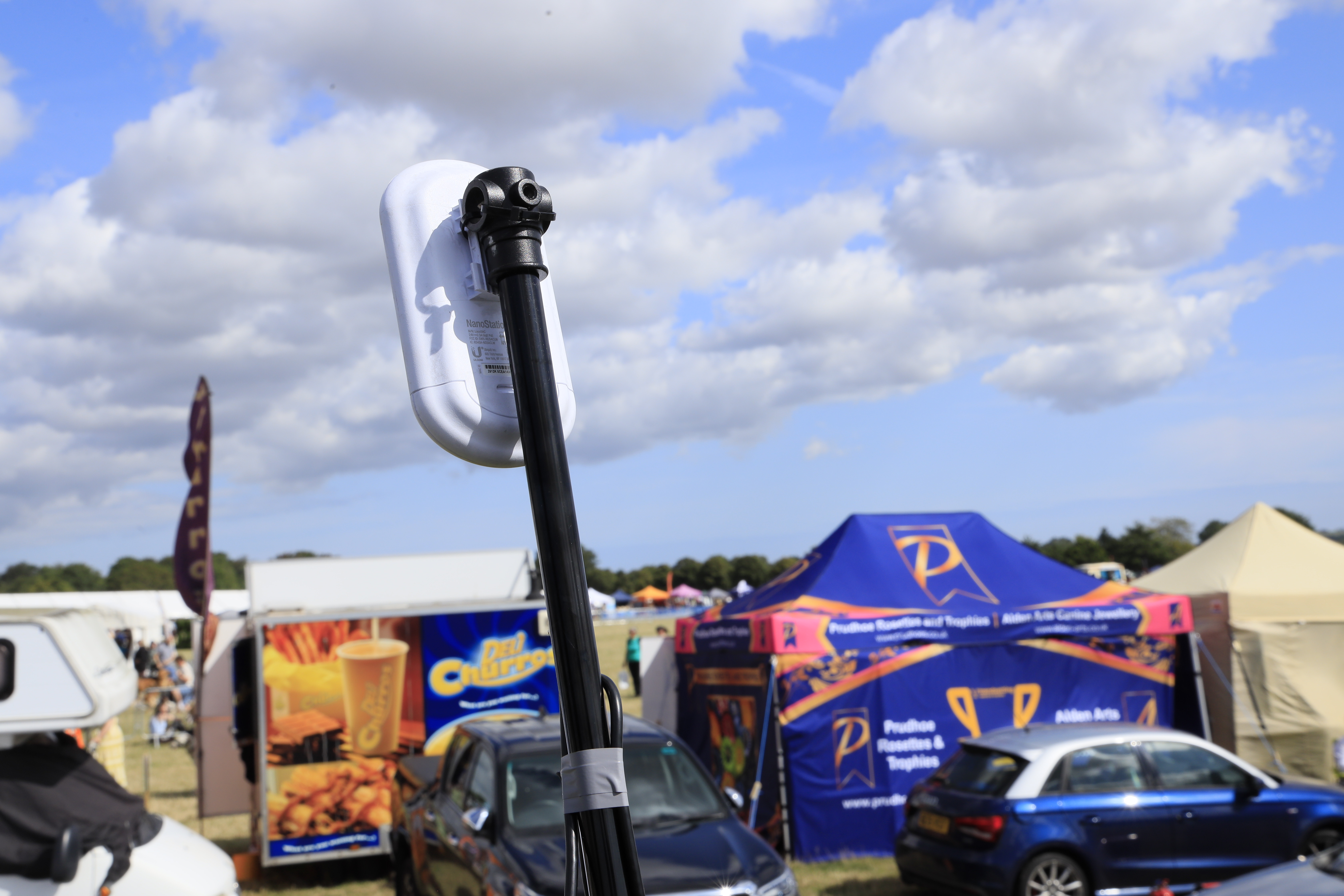
They need a network of their own, isolated from public WiFi, with a reserved share of bandwidth. Card terminals use very little data but are latency-sensitive and retry on failure. Cash fell to 9% of UK payments in 2024, so traders will take cards whether the site has planned for it or not.
Cash accounted for 9% of all UK payments in 2024, down from a third a decade earlier, and UK Finance forecasts it will reach 4% by 2034. Contactless is now 39% of every payment made in the country, debit cards are 53%, and half of UK adults regularly pay with a phone or watch.
Whatever your view on that, it settles one question for anyone running an event. A show set up to take cash is designing around a payment method used in fewer than one transaction in ten. The traders already know this, which is why almost all of them turn up with a card reader whether you have planned for it or not.
The question is no longer whether your event takes cards. It is whether it takes them reliably at half past two on Saturday, when everybody is at the bar at once.
The complaint lands on you, not the trader
This is the part organisers underestimate. When a card machine fails at a stall, the trader does not blame their payment provider or the mobile network. They blame the site. They tell the other traders in the row, they mention it in the post-event feedback, and they think about it when they are deciding which shows to book next year.
Trade stand income is a meaningful line for most county shows and festivals, and traders talk to each other constantly. A weekend of dropped payments is a retention problem, not just a technical one.
Why the 4G terminal in the trader’s pocket is not the answer
Most card readers ship with a SIM in them and will happily run on mobile data. Every payment provider markets this as a feature, and for a single trader at a farm shop that is entirely correct.
At an event it fails, and it fails for a specific reason.
Forty traders with 4G terminals are forty devices on the same congested cell as the five thousand attendees standing between them. Ookla measured average peak-time speed drops of 32% on 4G and 27% on 5G across European markets in 2026, and that is from ordinary domestic demand spread across a whole town. An event concentrates a town’s worth of people into a few hectares pointed at one or two masts.
Card terminals are not heavy users of data. They are, however, very sensitive to latency, and they retry. A terminal that cannot reach the acquirer inside a few seconds throws an error, the trader runs the card again, and now two transactions are queued on a network that could not carry one. Repeat across the whole trading row and the row grinds to a halt at precisely the busiest hour.
There is a coverage problem sitting underneath it too. All four UK networks together cover 84% of the UK landmass. At least one covers 96%. In that twelve-point gap, which is where a great many showgrounds and country parks sit, whether a trader can take a payment depends entirely on which network their terminal happens to be on. You will have traders on EE working fine and traders on O2 dead in the same row, and neither will understand why.
There is more on the mechanics of that in why mobile networks fail at events.
What a payment network actually needs
Not much bandwidth. A lot of separation.
Its own network, isolated from everything else. This is the whole trick, and it costs configuration rather than hardware. Card payments sit on their own network with their own reserved share of the bandwidth. Public WiFi sits on another. A field full of people uploading video physically cannot slow down a card terminal, because they are not sharing anything. Ticketing, production and welfare get the same treatment.
If you take one thing from this, take that. Almost every card payment failure we are called about at events comes down to payments sharing a network with the public.
Modest, reserved bandwidth rather than lots of it. Published figures vary enormously between EPOS vendors, from a few hundred kilobits per terminal up to 20 Mbps per device depending on whose documentation you read. That disagreement tells you the honest answer is to check what your specific traders are running rather than trusting a rule of thumb. What is consistent is that terminals need their share to be there when they ask for it, not to be large.
A second route to the internet. If the payment network depends on one connection, it has one point of failure and it will find it. Bonding several carriers means the coverage gaps do not line up. Where there is no useful mobile signal at all, Starlink provides a path that does not care what the local masts are doing. Where the site can take a fixed line, that is stronger still.
Coverage that actually reaches the trade rows. On a spread-out showground, the furthest stalls can be several hundred metres from wherever the connection lands. That is a distribution problem, and it is solved with cable runs, point-to-point links and access points placed along the rows rather than by hoping the signal carries.
Practical things worth doing before the gates open
Ask traders what they are running. Square, SumUp, Zettle, Dojo and a full EPOS till have different requirements and different failure modes. Ten minutes of asking beats a weekend of guessing.
Test on the busiest network, not the empty one. A card machine that works perfectly on Friday build day tells you nothing about Saturday afternoon. If you can, test under something like real load.
Give traders the network details in advance. Not on the morning, when everyone is setting up and nobody is reading anything.
Have a fallback that is not “the trader’s own 4G”. Because if the mobile network is struggling, that is the thing that has already failed.
Decide whether you are promoting public WiFi. If free WiFi goes on the wristband or the site map, take-up rises sharply and the network needs sizing for it. That does not have to affect payments if the separation is done properly, but it does need to be planned rather than discovered.
The short version
Cash is now under one in ten UK payments and heading for one in twenty-five. Your traders will take cards whether you have planned for it or not, and if it goes wrong on your site, you own the complaint.
The fix is not a bigger connection. It is a network where payments are kept apart from everything else, with more than one route out, and coverage that reaches the far end of the trade rows. That is a design decision made weeks before the event, not something anyone can rescue on the day.
More on how we handle it: EPOS and card payments, event trader WiFi and country show WiFi. For budgeting, see how much event WiFi costs.
Common questions
Because they are usually on the same congested mobile cell as the crowd, and terminals retry when they cannot reach the acquirer, which puts two transactions on a network that could not carry one.
At a busy event, yes. A SIM in a terminal is on the same cell as everyone standing in front of the stall. It works at a farm shop and struggles at a show.
Very little. Published figures vary hugely between EPOS platforms, from a few hundred kilobits to 20 Mbps per device. What matters is that the share is reserved and available on demand, not that it is large.
- UK Finance, UK Payment Markets 2025 (2024 data), published October 2025
- Ookla, peak-time mobile congestion across European markets, Q1 2026, via ISPreview, 4 May 2026
- Ofcom, Connected Nations update Spring 2026, 13 May 2026
- Published bandwidth requirements from mainstream EPOS platforms
Figures correct as of September 2026. We review this page every six months.
Talk to us about your event
Tell us the site, the dates and how many traders are taking payments. We will come back with a plan and a recommendation.
We can only deliver what is on the quote. Kit, coverage, extra zones, hardwired drops and on-site staff all need to be agreed and priced beforehand, so if you need something, ask us before the day rather than on it. Happy to add anything, we just need to know.
Thanks, we have got your enquiry and will come back to you shortly. Prefer email? Reach us at connect@propernorthern.co.